

Today in crypto, Hungry moved to decriminalize crypto trading, an AI researcher claimed to have jailbroken Anthropic’s latest AI model and the US CFTC proposed new rules for prediction markets with a focus on sports events contracts.
Hungary to reverse crypto trading crackdown after EU scrutiny
Hungary is set to decriminalize crypto trading, reversing restrictions that imposed potential jail terms for certain crypto-to-fiat and crypto-to-crypto transactions, according to Tisza government spokesperson Anita Köböl.
Speaking at a Thursday press conference, Köböl said Hungary would unwind rules introduced last year that required approved validation for crypto conversions and attached criminal penalties to violations. She said the restrictions contributed to a decline in crypto trading activity in the country.
“This was an unnecessary piece of legislation. It made practical operation impossible and frightened the market participants,” Köböl said, according to a translation by Cointelegraph. “The criminal consequences also negatively impacted several hundred thousand people.”

Hungary’s officials speaking at a press conference. Source: Péter Magyar/YouTube
The rules also prompted several digital asset platforms, including Revolut, to suspend crypto services in the country, Köböl said. She added that regulation had also led to a European Union probe into whether Hungary's restrictions were compatible with the bloc's rules.
The reversal would mark a policy shift for Hungary after its 2025 crypto framework created a restrictive approval system around crypto, exposing users and service providers to criminal liability.
Researcher claims he’s already bypassed Anthropic's Fable 5 guardrails
An artificial intelligence and cybersecurity researcher claims to have jailbroken Anthropic’s latest AI model, Claude Fable 5, within just 48 hours of it being launched.
“Pliny the Liberator,” a well-known figure in the AI community, said on Wednesday he “liberated” Fable 5, launched on Tuesday as a safety-tuned version of the more powerful Mythos model that Anthropic said was too dangerous to release widely.
He used various techniques, including a jailbroken version of Opus 4.8, to bypass the built-in safeguards that Anthropic installed on the model to prevent users from asking it for potentially harmful information, such as drug-making formulas or hacking instructions.
“Despite this overly sensitive, authoritarian ‘safety’ layer on top of Mythos, my lil liberators have been hard at work [...] cleverly finding the holes in the fence that the thought police missed,” said Pliny.
Some crypto users had already expressed concern during the launch of Claude Fable 5 and Mythos that it could be used to attack crypto protocols and software. A jailbroken version of Claude Fable 5 would mean the threat is even closer than expected.

Pliny demonstrates a path to meth synthesis by asking about the Birch reduction method. Source: Pliny
CFTC proposes framework favoring sports event contracts over gambling
The US Commodity Futures Trading Commission (CFTC) has proposed new rules for prediction markets, signaling that sports event contracts are generally not contrary to the public interest even though federal law classifies them as “gaming.”
Released on Wednesday, the proposal distinguishes sports event contracts from games of pure chance, saying markets based on final scores and win-loss records can aid price discovery. Contracts tied to player injuries, officiating decisions or other outcomes that could encourage manipulation, however, are unlikely to meet the public interest test.
The proposal also clarifies that election contracts are not considered “gaming” under the relevant federal laws.
Gary Kalbaugh, a partner at Cahill Gordon & Reindel LLP in New York, said the proposal is principles-based rather than a blanket approval, noting that each contract would still be subject to a case-by-case public interest analysis.
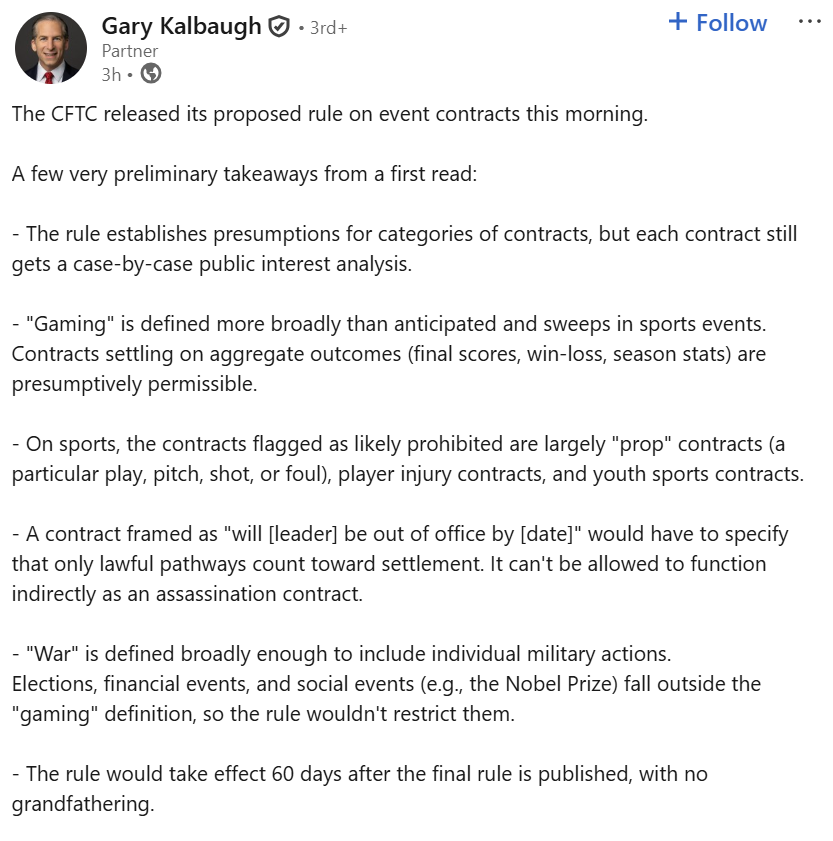
Source: Gary Kalbaugh


